Burner phones are prepaid phones you plan to drop, and they still exist
Burner phones are cheap prepaid phones bought without a contract, used for a short stretch, then dropped. The name comes from the habit of using one for a single job and getting rid of it afterwards. In a US shop the same device is labelled a prepaid or no-contract phone, so yes, they still exist in 2026.
How do burner phones work: you buy the handset and a prepaid SIM, add credit, and the carrier deducts minutes, texts and data from that balance until it runs out. There is no credit check and no monthly bill, and the account holds whatever name was typed at activation, if the carrier asked for one at all.
Most are simple flip or bar phones with no app store, which is part of the appeal: fewer sensors and fewer accounts. A cheap prepaid Android works as a burner too, as long as you never sign into it with an account that carries your name.
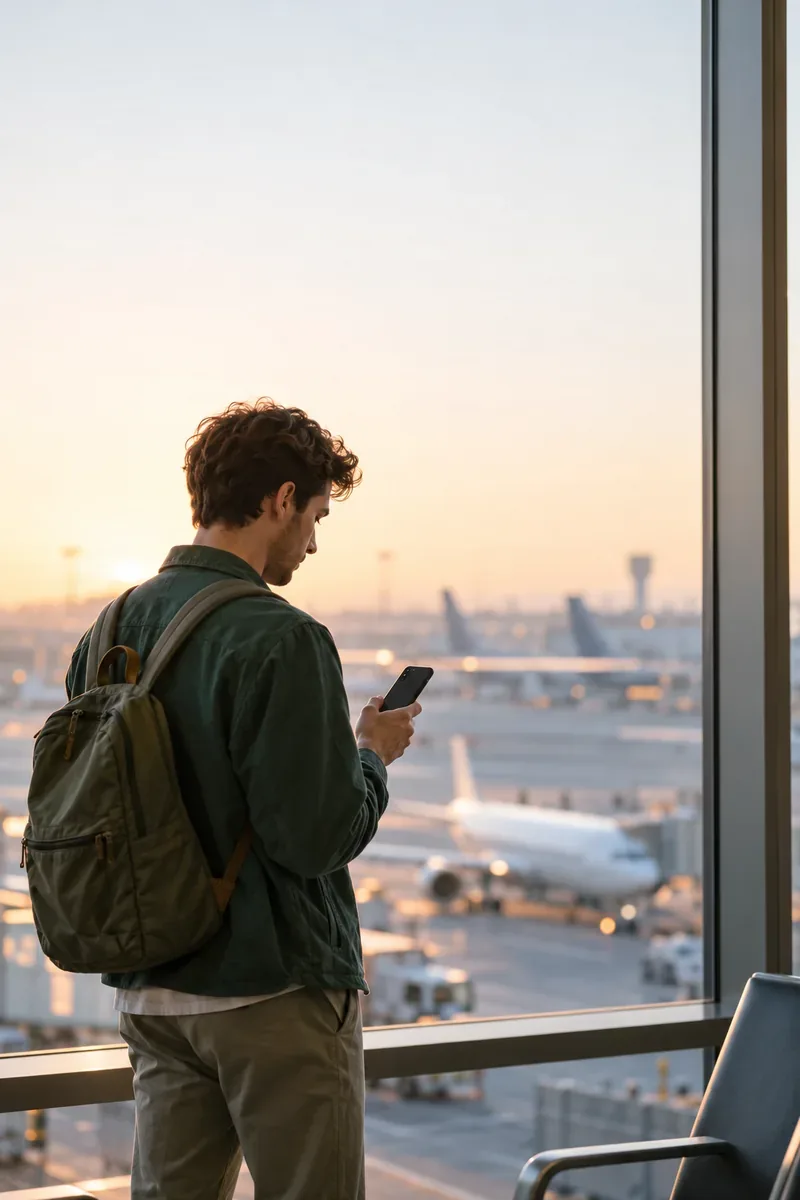
Where to buy burner phones in the US and what they cost
Burner phones are sold at Walmart, Best Buy and most carrier stores, filed under prepaid or no-contract phones. As of November 2026 Walmart lists a category called 'burner phone with a prepaid SIM already installed', and Best Buy lists prepaid handsets under 'all no-contract phones'.
How much are burner phones: we are not printing a price, because the shelf price changes by store and by week, and the credit packed in with the handset matters as much as the handset itself. The pattern holds everywhere: the phone is the cheap part, the ongoing cost is the top-ups that keep the number alive.
If you want the purchase itself kept off your name, pay cash at a counter rather than ordering online. An online order ties the phone to a delivery address and a payment account before it is even switched on.
- Is the SIM in the box, or sold separately?
- Which network is it on, and does that network have signal where you will use it?
- What is the smallest top-up that keeps the number active, and how often?
- Does the plan include data, if you want a VPN or a messaging app on it?
- Will the shop take cash?
A physical burner separates the hardware; a number app only separates the number
A physical burner phone keeps a separate handset, SIM and number; a number app gives you a second number on the phone you already carry. Both are useful, but they solve different problems.
A number app runs on your main phone, so the app maker and your main carrier still know who holds the device. That is fine for a dating sign-up or selling a sofa. It is the wrong tool if the whole point is that the phone itself should not be linked to you.
| Option | What is separate | What still points to you | Fits best for |
|---|---|---|---|
| Prepaid flip phone, paid in cash | Handset, SIM, number | Tower location, call pattern, store camera and receipt | Short contact with strangers, a spare for travel |
| Prepaid Android, paid in cash | Handset, SIM, number, apps | Same as above, plus any account you sign into | Travel, a second phone that can run a VPN and encrypted messaging |
| Number app on your main phone | The number only | Your main phone, your carrier account, the app maker's records | Online sign-ups, classifieds, dating |
| Second line or eSIM from your carrier | The number only | Your carrier account, in your name | Keeping clients apart from family |
Can burner phones be traced? Yes, they just lack a name on the account
Burner phones can be traced; what they lack is a name on the account, not a trail. The carrier logs every tower the phone connects to, every number it calls and texts, and the handset's IMEI. The store that sold it has a camera and a timestamp on the sale.
The link most people miss is the second phone in the same pocket. If the burner travels with your main phone, both report the same towers at the same times, and that pairing connects them without anyone touching either device. Calls and SMS on a basic phone are also unencrypted, as Proton VPN's guide points out, so the content is readable at the carrier.
We think most people over-worry about the handset and under-worry about habits. One call to your own mother from the burner undoes the whole exercise.
What a burner phone keeps separate
- Your name on the account
- Your main phone number
- Your main phone's apps and logins
- Your contacts list
What it does not change
- Tower location records at the carrier
- Call and text records at the carrier
- The handset's IMEI
- The store's record of the sale
- Unencrypted SMS and voice calls
How to use a burner phone so nothing on it points back to you
A burner phone protects you only if nothing on it leads back to you, and that is about habits more than hardware. The steps below are the ones we would follow ourselves.
Pay cash and skip the loyalty account
Buy at a counter, pay cash, and decline the receipt-by-email and rewards prompts. Each one attaches an identity to the sale.
Activate it away from your home connection
Set it up somewhere other than your home Wi-Fi, and type nothing real if the activation asks for a name or address where none is required.
Keep your main accounts off it
Never sign into your Google account, Apple ID or main messaging account on the burner. On an Android burner, make a new account with a new email for the app store.
Do not carry both phones together
Two phones that move through the same towers at the same times look like one person. Leave the main phone at home, or power it down before the burner comes out.
Keep the circle of contacts separate
Do not call or text anyone from the burner who is also in your main phone. The pattern of who you contact identifies you faster than the number does.
Decide when the number dies
Either keep topping up so the number stays active, or let the balance lapse on purpose when the job is done. Know which one you are doing.
Dispose of it properly
Factory reset the handset, pull the SIM and destroy it, then recycle the phone. Proton VPN's guide covers disposal in detail.
Does a burner phone need a VPN?
A VPN on a burner phone covers the one thing a prepaid SIM leaves open: the carrier can still see which sites and apps you use over its data. The burner takes your name off the SIM; the VPN takes the browsing trail off the carrier's logs.
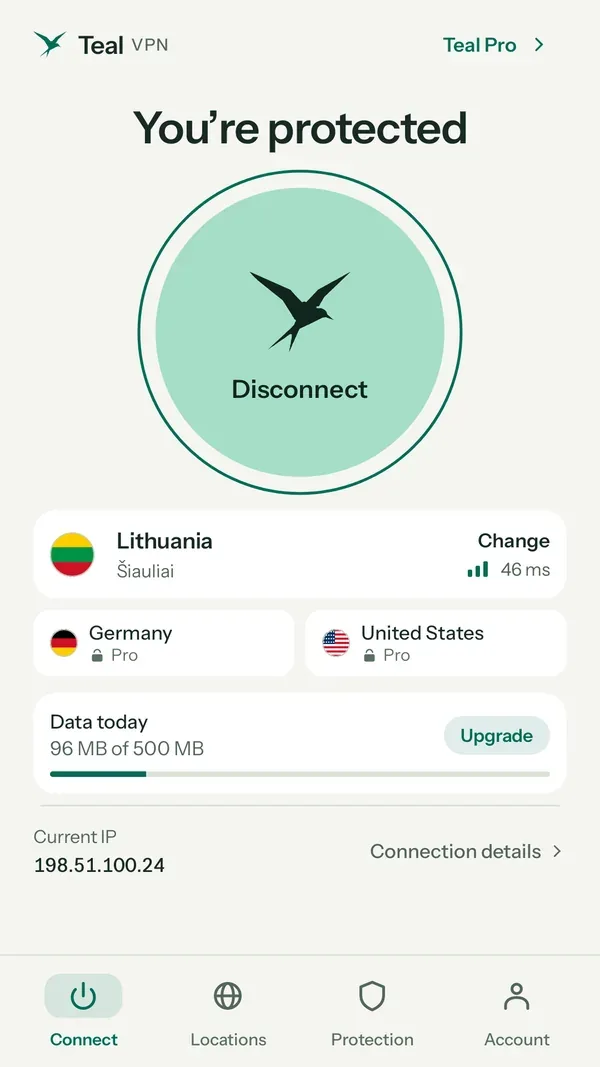
Teal VPN, made by Fxolio LLC, has a Free plan (500 MB a day, 2 devices, nothing beyond an email at sign-up) and a Pro plan, with apps for Android, Windows, Mac, Linux, Android TV and Chromebook. Every connection uses Teal Secure, which obfuscates the traffic so the carrier sees only encrypted data to one server, and the app tries other routes by itself when a network closes one. No VPN is guaranteed to connect on every network.
Two honest limits: a VPN does nothing for calls and SMS, which travel over the carrier, and it does not change the tower record or the IMEI. Teal VPN has no iPhone app as of November 2026, so a used iPhone as a burner is out for us. Run Teal VPN's leak test at tealvpn.com/ip-leak-test before and after connecting; the DNS line should switch from the carrier's servers to the VPN's, and ipleak.net gives a second opinion.
- 500 MB a day
- Teal Free2 devices, email only
- $36 a year
- Teal Pro$3 a month, up to 10 devices; $7.99 monthly
- 30 days
- money-backon Pro plans, as of November 2026
- 14
- server countriessame list on Free and Pro
Most people who want a burner phone actually want a second number
Most people who want a burner phone actually want a second number, and there are cheaper ways to get one. A second line or eSIM from your own carrier keeps work and family apart and bills with your plan, though it carries your name. A number app does the same for online sign-ups and classifieds, with the app maker in the middle.
For travel, a local prepaid SIM in your existing phone gives you a local number and avoids roaming fees, which is one of the reasons Proton VPN lists travelers among burner users. The handset's IMEI still travels with you, so it is a convenience move, not a separation move.
For browsing privacy alone, a VPN on your main phone does more than a burner does. The burner moves your name off the SIM; the VPN keeps the sites you visit off the carrier's logs. They solve different problems, and on a trip to a country with strict networks, such as China or Iran, we carry both.
Keep reading
References
- Norton: What is a burner phone? How they work and when to use one
- Wikipedia: Prepaid mobile phone
- Proton VPN: What is a burner phone and how do you use it?
Need help with Teal? Contact support.
Questions
How long do burner phones last?
The handset lasts for years; the number lasts only while the prepaid balance is active. Each carrier prints an inactivity window in its plan terms, after which the number is recycled, so an occasional top-up keeps it alive.
Are burner phones illegal?
Buying and using a prepaid phone is an ordinary retail purchase in the US. What differs by country is whether the SIM must be registered to an ID, which 155 countries required in 2020 by Wikipedia's count. Check the local rules before you travel.
Can burner phones be traced by police?
Yes, through the carrier's tower and call records, the handset's IMEI and the store that sold it. A burner removes your name from the account; it does not stop the records being kept.
Do burner phones have cameras?
Most do, even basic flip phones, though the quality is poor. If the camera worries you, pick a model whose spec sheet lists none, or cover the lens.
Does Walmart sell burner phones?
Yes. As of November 2026 Walmart lists a category called 'burner phone with a prepaid SIM already installed', and Best Buy lists prepaid handsets under 'no-contract phones'. Prices are on the listings and change often, so we do not quote them.
Should I carry a burner phone across the US border?
Some travelers carry a travel phone with only what they need on it and leave the main phone at home; a phone with few accounts has little to show. Rules on device checks differ by country, so check the local rules before you travel.
Can I run Teal VPN on a burner phone?
On an Android burner, yes: install the Teal VPN app, sign up with an email, and Teal Free gives 500 MB a day on 2 devices. There is no iPhone app as of November 2026.