A good VPN in Canada needs three things before any ranking
The best VPN in Canada is one with servers in Toronto, Montreal or Vancouver, a written policy that says browsing is not logged, and a price that stays the same when the plan renews. Every roundup we read agrees on the first two and glosses over the third.
Device coverage comes next. Count the devices in your home that will run the app at the same time, then read the plan's connection limit. Teal VPN allows up to 10 devices on the yearly plan and 5 on the monthly and six-month plans; Surfshark advertises unlimited connections.
Then look at the renewal price, not the headline price. Several big names advertise 75% or 87% off for the first term and renew much higher; Top10VPN lists "renews at a much higher price" as a con for its own top pick.
- A server city within a few hundred kilometres of you
- A logging policy that names what is not kept
- The renewal price printed next to the intro price
- Apps for every device you own, not just phones
- A refund window you can actually use (Teal VPN: 30 days)
Canadians turn a VPN on for their internet provider, not for secrecy
Most people in Canada use a VPN for one reason: their internet provider can see every site they visit, and they would rather it did not. A VPN encrypts traffic between your device and the VPN server, so the provider sees only that you are connected to a VPN.
Shared Wi-Fi is the second reason. Coffee shops, airports and hotel networks are shared with strangers, and a VPN keeps your traffic sealed from the people on the same network.
Data breaches are the third, and reviewers are right to flag them, with one caveat: a VPN protects traffic in transit, not a password you reused on a site that was breached.
According to 2025 data, Canada is the seventh most affected country by data breaches globally, with 8 million accounts breached that year.
Surfshark, Canada servers page
Speed in Canada is mostly about distance to the server
Speed in Canada comes down to how far you are from the server, not the brand on the app. Connect to the Canadian city nearest you and most good VPNs lose little; connect from Vancouver to a Montreal server and every VPN feels slower.
Teal VPN has servers in Canada, but we have not published a Canadian speed test as of October 2026, so we will not quote a number we did not measure. Cyberinsider reports 95%+ of baseline speed for its top pick on Canadian servers; treat that as the bar any provider should clear.
Install the app on the device you use most
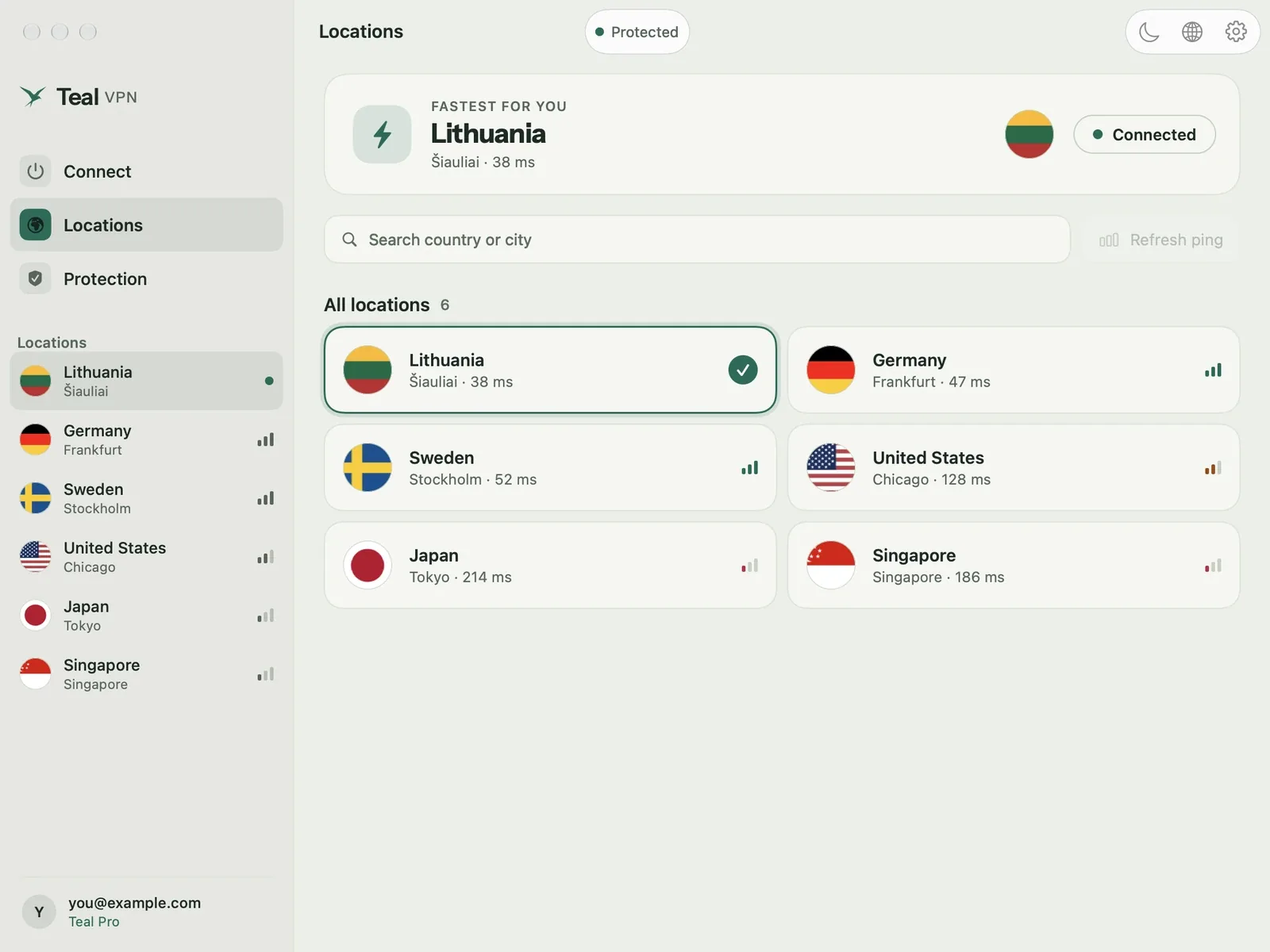
Teal VPN has apps for Android, Android TV, Windows, Mac, Linux and Chromebook. Sign in with the email you used to register.
Pick Canada in the location list
If the app offers a city, choose the one closest to you. If you are outside Canada and want a Canadian address, choose Canada and connect.
Confirm the address and DNS at tealvpn.com/ip-leak-test
With the VPN on, Teal VPN's test at tealvpn.com/ip-leak-test shows your public IP and the DNS servers answering your lookups. Both should point to the VPN, not your provider. It needs no sign-in and works with any VPN.
| What to check | Why it matters | Where to look |
|---|---|---|
| Server city nearest you | Distance adds latency; Toronto to Vancouver is a long round trip | The provider's server list |
| Servers per city | Crowded servers slow down at peak hours | Surfshark lists 242 servers across 3 Canadian cities as of October 2026 |
| Speed kept with the VPN on | Reviewers measured 95%+ of baseline for the top pick | Cyberinsider's Canada tests, September 2026 |
| Your own result | Only your line and your city count | A speed test before and after connecting |
Logs and leaks decide privacy, not encryption acronyms
Two things decide how private a VPN really is: what it writes down and whether it leaks. Encryption acronyms matter far less, because every serious provider uses strong ciphers.
Jurisdiction is the roundups' favourite point. Cyberinsider argues a VPN headquartered in Canada is a weak choice because Canada shares intelligence with partner countries. Teal VPN is run by Fxolio LLC in the United States, and we will not pretend that is a better address; what protects you is that we keep no browsing logs, so there is nothing to hand over.
Audits and leak tests are how you check the claim instead of trusting it. Surfshark lists a 2025 no-logs assurance report; ask any provider for the date of theirs. For leaks, run tealvpn.com/ip-leak-test with the VPN on, then compare against dnsleaktest.com or browserleaks.com as a second opinion. If a kill switch matters to you, check the provider lists it for your exact platform before paying; feature lists differ between Windows, Mac and Android.
A VPN that charges nothing has to earn money another way
A VPN that charges nothing has to pay for servers somehow, and the usual answers are ads, a data cap or your browsing data. Top10VPN names Windscribe and PrivadoVPN as the two no-cost options it trusts, and still notes that many such services have no Canadian servers at all.
Teal Free is our version: 500 MB a day, 2 devices, nothing asked beyond an email, and no ads. That is enough for banking, email and maps on hotel Wi-Fi, not for video.
Streaming and torrenting: what roundups promise and what we won't
Roundups rank Canadian VPNs heavily on whether they open US Netflix, Crave or CBC Gem; we do not test streaming and make no promise about any service. Platforms change what they allow from week to week, and a page that promises access today can be wrong tomorrow.
Torrenting is similar. Some providers advertise P2P servers; we do not market Teal VPN for torrenting. A VPN encrypts the download, it does not change the copyright rules that apply where you live.
If streaming is your main reason for buying, read the review's test date, then use the refund window to check the service yourself in the first week.
What Teal VPN costs and who it suits
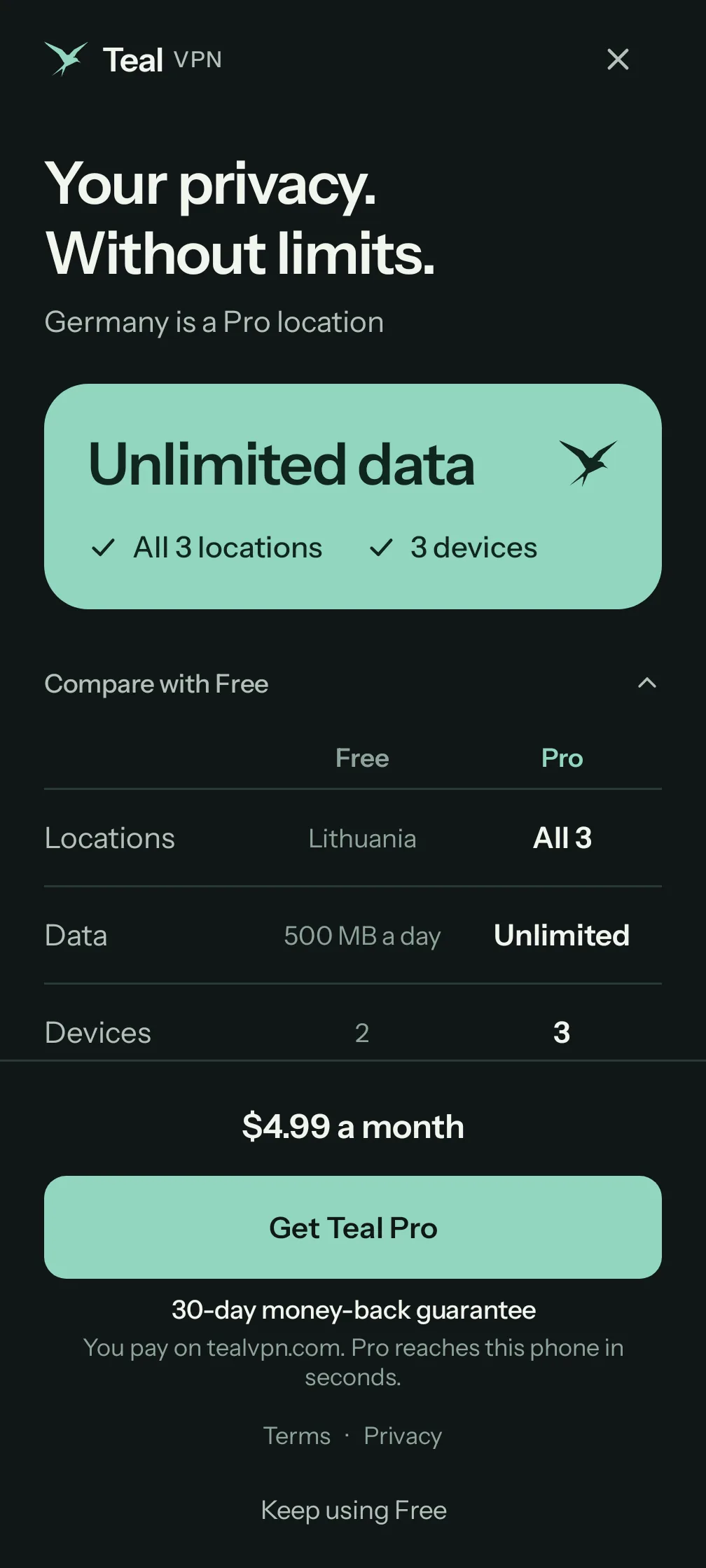
Teal VPN costs $36 a year ($3 a month), $24 for six months or $7.99 monthly, with a 30-day money-back window on paid plans, as of 23 October 2026. The price you see is the price at renewal.
Apps cover Android, Android TV, Windows, Mac, Linux and Chromebook (Play app or Chrome extension), plus Chrome, Edge and Firefox extensions. We do not have an iOS app as of October 2026, so iPhone users should look elsewhere for now.
Pay by card, Apple Pay, Google Pay, PayPal or crypto. Servers sit in 13 countries: Australia, Canada, France, Germany, Japan, Lithuania, Netherlands, Singapore, South Korea, Sweden, Switzerland, the United Kingdom and the United States.
- $3
- a month on the yearly plan$36 billed yearly
- 30 days
- money-back on paid plans
- 14
- server countries, Canada included
| Plan | Price (USD) | Works out to | Devices at once |
|---|---|---|---|
| Monthly | $7.99 | $7.99 a month | 5 |
| Six months | $24 | $4 a month | 5 |
| Yearly | $36 | $3 a month | 10 |
| Teal Free | $0 | 500 MB a day | 2 |
Leaving Canada: strict networks and local rules
If you take a Canadian VPN abroad, the question changes from speed to whether the network lets a VPN connect at all. China, Iran and Turkey run strict networks where ordinary VPN connections often fail, and no VPN works everywhere.
Teal Secure obfuscates every connection on every plan, so the traffic looks like ordinary web traffic, and the app tries other routes by itself when a network closes one. We built it for exactly these networks, and we still tell people to install and test before they board.
Check the local rules before you travel. We do not give legal advice about any country, and roundups that settle the question in one sentence are simplifying.
Before you leave
- Install and sign in at home
- Put the app on every device you are taking
- Save the support email somewhere offline
On arrival
- Connect before opening other apps
- Let Teal Secure retry routes if the first try fails
- Run tealvpn.com/ip-leak-test once connected
Keep reading
References
- Cyberinsider: Best VPN for Canada – Which performs best in 2026?
- Top10VPN: The Best VPNs for Canada
- Surfshark: Canada VPN servers
Need help with Teal? Contact support.
Questions
What is the best VPN for Canada if I am in the United States?
Any VPN with Canadian servers will give you a Canadian address; pick Toronto or Montreal from the east coast and Vancouver from the west for the shortest hop. Teal VPN has Canada servers on every plan, including Teal Free.
What is the best VPN to use in Canada?
One with servers in Toronto, Montreal or Vancouver, no browsing logs and a renewal price equal to the sign-up price. Roundups rank NordVPN, Surfshark and ExpressVPN highest; Teal VPN meets the same three tests at $3 a month on the yearly plan.
Are VPNs allowed in Canada?
We do not give legal advice. Major providers run Canadian server pages openly and roundups discuss the question at length; read those and check the local rules where you are.
Does my internet provider know I am using a VPN?
With an ordinary VPN, the provider sees encrypted traffic going to a VPN server's address, which is a fairly clear sign. Teal Secure obfuscates every connection so the traffic looks like ordinary web traffic, which makes it harder to tell apart.
Which VPN has the most servers in Canada?
Surfshark lists 242 servers across Montreal, Toronto and Vancouver as of October 2026, and Top10VPN counts 7,130 servers worldwide for NordVPN. Servers near your city matter more than the total.
Is there a good VPN for Chrome in Canada?
Teal VPN has Chrome, Edge and Firefox extensions. An extension protects only that browser; use the Windows, Mac or Linux app when you want the whole device covered.
What is the best logless VPN in Canada?
Logless means the provider keeps no record of the sites you visit. Teal VPN keeps no browsing logs and shows no ads; for any provider, ask when their last independent audit was published.