A kill switch stops a system fast, even if that costs something
A kill switch is a control built to interrupt a machine or a program as quickly as possible, skipping the orderly shutdown. The point is speed and simplicity: a panicked operator, or a bystander, must be able to work it without training.
The same name covers very different things. An emergency stop button on a factory press, a lanyard on an outboard motor, a relay that stops a car from starting, and a setting in a VPN app that cuts the internet when the tunnel drops are all called kill switches.
The word also names a Penelope Douglas novel, a pre-workout powder and proposed rules for shutting down AI systems. None of those are on this page; the hardware and software kinds are.
A kill switch is designed and configured to abort the operation as quickly as possible (even if it damages the equipment) and to be operated simply and quickly.
Wikipedia, Kill switch, read 2 November 2026
Every kill switch opens one circuit the system cannot run without
A kill switch works by opening a single circuit or path, so the whole system halts even though everything else is intact. In a car that circuit is the starter, the ignition or the fuel pump; on a boat it is the engine's ignition; in a VPN app it is the network path for every packet that is not inside the tunnel.
A dead man's switch runs the logic backwards. The circuit stays closed only while the operator holds a handle, sits in a seat or keeps a cord clipped to a wrist; let go and the machine stops. Locomotives, riding mowers and personal watercraft use this form.
Two details decide whether a kill switch is any good: whether it can be reached in a hurry, and whether it can be pressed by accident. Industrial E-stops get a plastic cover, called a molly-guard, for the second problem.
| Type | What it interrupts | Where you see it |
|---|---|---|
| Emergency stop (E-stop) | Power to the whole machine | Machine tools, amusement rides, elevators |
| Dead man's switch | A circuit held closed only while the operator holds it | Locomotives, riding mowers, jet skis |
| Starter or ignition interrupt | The starter, ignition or fuel pump circuit | Cars, trucks, rental and dealer fleets |
| Battery disconnect | All power from the battery | Stored vehicles, boats, race cars |
| Steering-wheel kill | The engine, when the accelerator sticks | NASCAR stock cars |
| VPN kill switch | All internet traffic outside the tunnel | VPN apps on laptops and phones |
A car kill switch stops the engine starting; it is not a brake
In a car, a kill switch almost always means a starter interrupt: a switch or relay that opens the starter, ignition or fuel pump circuit so the car will not start, even for someone holding the real key or a cloned fob. It does nothing once the engine is running, and a responsible design never cuts power at speed.
The common forms are a toggle or pushbutton wired into one of those circuits, a drop-in relay that plugs into the fuse box in place of the factory relay, a wireless version with two remotes, and GPS-linked immobilizers that rental companies and buy-here-pay-here dealers control from software. A battery kill switch is a different animal: it sits on the battery terminal and cuts everything, which suits storage and trailers more than daily driving.
The best place to put a kill switch in a car is somewhere the driver reaches without looking and a stranger would not guess: under the dash, inside the console, behind a trim panel. Wireless relay kits skip the hardest part of a wired install, which is routing a wire from the engine bay into the cabin.

- $108
- wired drop-in relay kit41.22 Drop-In Kill Switch, 2 November 2026
- $179
- wireless kit with two remotesinstall rated 1 of 5 for difficulty by the maker
- 15 min
- one reviewer's install timewired kits are rated 2 to 3 of 5
A VPN kill switch cuts your internet the moment the tunnel drops
A VPN kill switch is a setting in the VPN app that stops all traffic, or traffic from chosen apps, the instant the VPN connection fails, and holds it until the tunnel is back. Without it, every app on the device quietly carries on over the plain connection, and your real IP address and DNS lookups go out for the seconds or minutes before you notice.
Tunnels drop more often than people think: a laptop waking from sleep on a new network, a phone walking from Wi-Fi to mobile data, a hotel router that resets at 3 a.m., or a strict network that closes the route a VPN was using. The kill switch is for that gap.
Teal VPN, made by Fxolio LLC, has a Free plan (500 MB a day, 2 devices) and a Pro plan, with apps for Android, Windows, Mac, Linux, Android TV and Chromebook. Its apps run Teal Secure, which obfuscates every connection on every plan, and the automatic route switch, which tries other routes by itself when a network closes one. As of 2 November 2026 that is what our feature list names; it does not list a separate kill switch toggle, so we will not claim one here.
- Your VPN app shows reconnecting more than once a day
- You use public Wi-Fi that drops when you walk between rooms
- You run long downloads that keep going when the tunnel dies
- Your laptop sleeps and wakes on a different network most days
- You would rather be offline for a minute than leak for a second
Which VPN encrypts every app connection and includes a kill switch?
Any full-device VPN app, as opposed to a browser extension, encrypts every app's connection; a kill switch is a separate setting you confirm on the vendor's own feature page, and the names that come up most for it are Proton VPN, NordVPN and ExpressVPN. Teal VPN encrypts every app on the device and adds the automatic route switch, but its published features do not include a kill switch toggle as of 2 November 2026.
One honest limit applies to every row: a kill switch only guards the gap after a drop. No VPN is guaranteed to connect on every network, and a kill switch does nothing if the app was never running.
The extension trap catches a lot of people. Teal VPN's Chrome, Edge and Firefox extensions cover the browser only; the Windows, Mac, Linux and Android apps cover every app. The same split applies to most other vendors.
| Option | Encrypts every app? | Kill switch | What we checked, 2 November 2026 |
|---|---|---|---|
| Teal VPN (desktop and Android apps) | Yes, on the device apps; extensions cover the browser only | Not listed; automatic route switch reconnects on its own | Our own feature list and prices |
| Proton VPN | Yes, with its device apps | Confirm on its own feature page | Named most often for this question; we did not test it this week |
| NordVPN | Yes, with its device apps | Confirm on its support site | Named often; not tested by us this week |
| ExpressVPN | Yes, with its device apps | Confirm on its own feature page | Named often; not tested by us this week |
Test a VPN kill switch in five minutes with a leak test and a forced drop
The only proof a kill switch works is forcing a drop and watching what loads. Teal VPN's leak test at tealvpn.com/ip-leak-test shows your public IP and the DNS servers answering your lookups, needs no sign-in and works with any VPN; dnsleaktest.com is a fine second opinion.
We have not run a timed drop test this week, so there are no numbers here, only the procedure we use ourselves.
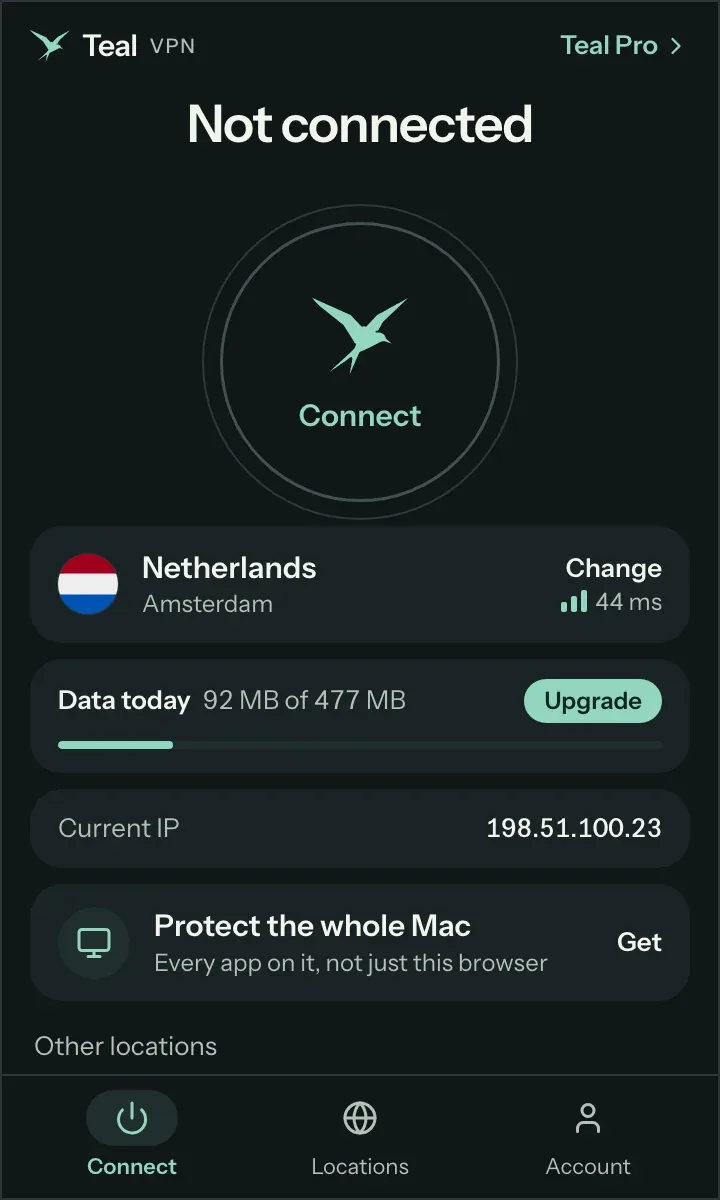
Note your real address
With the VPN off, open tealvpn.com/what-is-my-ip and tealvpn.com/ip-leak-test. Write down the IP and the DNS line.
Connect and confirm
Turn the VPN on and reload the leak test. The IP should belong to the VPN server and the DNS line should not show your internet provider.
Turn the kill switch on
Find it in the VPN app's settings. If there is an always-on or permanent option, pick that one; it also covers the moments before the app has connected.
Force a drop
Switch Wi-Fi off and on, pull the Ethernet cable, or toggle airplane mode on a phone. Some apps also let you end the VPN process from the task manager, which is the harshest test.
Reload during the gap
A working kill switch means the leak test page does not load at all until the tunnel is back. A failing one shows the real IP you wrote down in the first step.
Repeat after sleep
Close the laptop lid, wait a minute, open it on a different network and reload. Sleep and wake is where most leaks happen in our experience.
Pick the kill switch by what you need stopped, then by who will reach it
Choose a kill switch by naming the one thing it must stop, because a starter interrupt, a battery disconnect and a VPN setting solve three different problems. Theft deterrence wants a starter interrupt; long storage wants a battery disconnect; a laptop on strange Wi-Fi wants the VPN setting.
For a car, check fit before you buy: drop-in relay kits only match vehicles whose fuse box uses a relay the kit can replace, which is why makers ask for the model or VIN first. Keep the original relay so the car can go back to stock, and if you would rather not route wires, a car audio or alarm shop does this kind of installation.
For a VPN, we think most people over-worry about which brand has the fancier kill switch and under-worry about whether they ever tested it. Run the forced-drop test above once; the result tells you more than any feature list.
Do
- Match the type to the job: interrupt for theft, disconnect for storage
- Confirm vehicle compatibility before ordering a relay kit
- Keep the factory relay so the install is reversible
- Test a VPN kill switch with a forced drop, then again after sleep
Don't
- Fit anything that cuts power while the car is moving
- Mount a button where a passenger can press it by accident
- Assume a browser extension protects other apps on the device
- Trust the word connected in the app without checking the IP
Keep reading
References
- Kill switch, Wikipedia
- What is a Kill Switch and Why Do You Need One?, Trackhawk GPS
- Drop-In Kill Switch, Vehicle Immobilizer, 41.22
Need help with Teal? Contact support.
Questions
What is a kill switch?
A kill switch is a control that stops a system as fast as possible by opening one circuit it cannot run without. The term covers emergency stop buttons, boat lanyards, car starter interrupts and a VPN setting that cuts internet when the tunnel drops.
What is a VPN kill switch?
A VPN kill switch is a setting that stops all traffic, or chosen apps, the instant the VPN connection fails and holds it until the tunnel is back. It keeps your real IP and DNS lookups from going out during the gap.
What is a kill switch in a car?
A car kill switch is usually a starter interrupt: a switch or relay that opens the starter, ignition or fuel pump circuit so the car will not start, even with the real key or a cloned fob. It stops a start, not a moving car.
How much is a kill switch for a car?
As of 2 November 2026, the 41.22 drop-in relay kit costs $108 wired and $179 wireless with two remotes, and one reviewer installed it in 15 minutes. Simple toggle switches from auto parts stores cost less but need wiring.
Does Teal VPN have a kill switch?
As of 2 November 2026 Teal VPN's published features name Teal Secure, which obfuscates every connection on every plan, and the automatic route switch, which tries other routes by itself when a network closes one. A separate kill switch toggle is not on that list, so we do not claim one.
Which VPN encrypts every app connection and includes a kill switch?
Any full-device VPN app encrypts every app's connection; the kill switch is a setting you confirm on the vendor's own feature page, and Proton VPN, NordVPN and ExpressVPN are the names that come up most. Teal VPN encrypts every app on its device apps and reconnects by itself, without a listed kill switch toggle.
What is the difference between a battery kill switch and an ignition kill switch?
A battery kill switch sits on the battery terminal and cuts all power, which suits storage, boats and race cars. An ignition or starter kill switch opens only the circuit needed to start, so the car keeps its memory and the switch can be used every day.