A no logs VPN keeps nothing that ties you to what you did online
A no logs VPN does not record which sites you visited, which server you used, your real IP address, your DNS lookups or what you downloaded while connected.
The word logs covers three different things, and many policies only promise to skip the first. The table below is the split we use when we read a rival's policy.
Teal VPN's rule is no browsing logs: nothing from the usage row is written anywhere. We cannot produce a list of the sites you visited because no such list exists on our side.
| Type of log | What it contains | Can it identify you? | What a real no-logs policy says |
|---|---|---|---|
| Usage logs | Sites visited, DNS queries, downloads, destination IPs | Yes, directly | Never kept, stated plainly |
| Connection logs | Your real IP, server used, connect and disconnect times, bytes used | Yes, when combined | Not kept, or kept only in memory and never written to disk |
| Aggregate counts | Total users on a server, total traffic per server | No | Allowed; a provider needs it to know which server is full |
How VPNs compare on privacy, logging and tracker filtering
The honest comparison is three things: the date of the latest audit, the exact data the audit says is not kept, and whether the app itself carries ads or ad identifiers.
Tracker filtering is a separate feature from logging. A filter in the app stops known tracker domains before they load, but it tells you nothing about what the provider stores about you. Teal VPN does not bundle a tracker filter; the promise is simpler: no browsing logs and no ads in the app.
One limit applies to every row: an audit covers the days the auditor looked. No table can prove what a provider does next month.
| VPN | What backs the no-logs claim | As of |
|---|---|---|
| X-VPN | Independent audit under ISAE 3000 (Revised) by a Big Four firm, completed 28 February 2026; audit lists real IPs, sites visited, DNS queries and servers used as not stored. Announced in a paid press release. | 6 June 2026 |
| Proton VPN | Publishes independent no-logs audit reports on its own site; Techlicious named it the best pick among plans that cost nothing. | 24 April 2026 |
| Mullvad | Publishes independent no-logs audit reports on its own site; read the newest report for its date and scope. | October 2026 |
| Surfshark | Techlicious' best VPN for most people; its logging claim is stated on its own policy page, so read that page, not the review. | 24 April 2026 |
| NordVPN | Techlicious' pick for working from home; check the date of its latest published audit on its support site. | 24 April 2026 |
| Teal VPN | No browsing logs and no ads on every plan, including Teal Free; Teal Secure on every connection. No third-party audit published yet, which we say plainly. | 31 October 2026 |
You can check a no-logs claim yourself in ten minutes
Read the privacy policy, find the audit date, open the app store listing, and run a leak test while connected; those four checks catch most weak claims.
We do this for every rival we compare against, and the store listing is where most surprises turn up. A policy can say no logs while the listing admits the app shares an advertising ID.
- The policy has no list of data that is not kept
- The audit has no date, or the provider shows a badge but no report
- The store listing admits an advertising ID or device ID is shared
- The app shows ads of its own
- No named company stands behind the service
Open the privacy policy, not the homepage
Look for a list of what is not kept: real IP address, sites visited, DNS queries, server used, timestamps. A policy that only says 'we may collect' with no list is a policy that keeps something.
Find the audit report and its date
A badge that says 'audited' is not a report. X-VPN's audit, for example, ran under ISAE 3000 (Revised) and finished on 28 February 2026, so you know exactly which window it covers. An audit with no date covers nothing you can rely on.
Read what the app collects on the store listing
The Data safety section on Google Play and the App Privacy card on the App Store list crash data, device IDs and advertising identifiers that the policy may skip. If an advertising ID is listed, the app is feeding an ad network.
Check what signing up requires
Teal Free needs only an email; Teal Pro needs an email and a payment by card, Apple Pay, Google Pay, PayPal or crypto. The less a service holds about you, the less it can hand over or lose.
Run a leak test while connected
Teal VPN's leak test at tealvpn.com/ip-leak-test shows your public IP and the DNS servers answering your lookups, with no sign-in and with any VPN. If your internet provider's DNS appears, your lookups are leaving the tunnel no matter what the policy promises.
Which VPN has a strict no-logs policy and does not show ads
Teal VPN keeps no browsing logs and shows no ads on any plan, including Teal Free; Proton VPN and Mullvad are the names people reach for when they want a published audit behind the claim.
Teal VPN, made by Fxolio LLC in the United States, has a Free plan (500 MB a day, 2 devices, only an email to sign up) and a Pro plan, with apps for Android, Android TV, Windows, Mac, Linux and Chromebook, plus Chrome, Edge and Firefox extensions. Teal Secure obfuscates every connection on every plan so the tunnel looks like ordinary traffic on networks that restrict VPNs, and the app tries other routes by itself when a network closes one. No VPN is guaranteed to connect on every network.
The honest limit on our side: as of October 2026 we have not published a third-party audit of the no-logs policy. If an audit report is the thing you need before you pay, Proton VPN or Mullvad answers that today and we do not.
- $3.00
- per month on the yearly plan$36 a year, checked 31 October 2026
- 30 days
- money-back on Proany payment method
- 14
- server countriessame on Teal Free and Pro
- 10
- devices on the yearly plan5 on monthly and 6-month
An audit proves one day, not every day
A no-logs audit shows that on the dates the auditor looked, the servers and processes matched the policy; it cannot promise the same next month.
X-VPN's 2026 audit is a useful example of what a real one covers. It was organized around five areas: sensitive activity data is not stored, only the minimum user information is processed, servers and databases and code stay secure through deployment and maintenance, the policy matches actual operations, and data-protection oversight works independently. It was announced in a paid press release on 6 June 2026, so read the report, not the headline.
We think the audit date matters more than the audit badge. A report from years back tells you about years back, and a provider that keeps re-auditing is telling you more than one that framed a single certificate.
Some VPNs have actually been accused of spying on their own customers' traffic for marketing purposes or worse. And it's not just obscure providers, either.
Suzanne Kantra, Techlicious, 24 April 2026
A VPN that costs nothing and keeps no logs is rare, so read the listing
Most VPN apps that cost nothing pay for their servers with ads or with your data, which is the opposite of no logs.
Techlicious cited a Zimperium zLabs study in April 2026 that found hundreds of such VPN apps request excessive permissions, use outdated code, and in some cases behave more like spyware than privacy tools. The store listing's data section is where you catch this before you install.
Teal Free is our answer to that problem: 500 MB a day, 2 devices, only an email to sign up, no ads, and the same Teal Secure connection as Pro. The limit is the daily cap, and we would rather say that than fund the servers with your data.
A no-logs policy does not stop a DNS leak, so test it
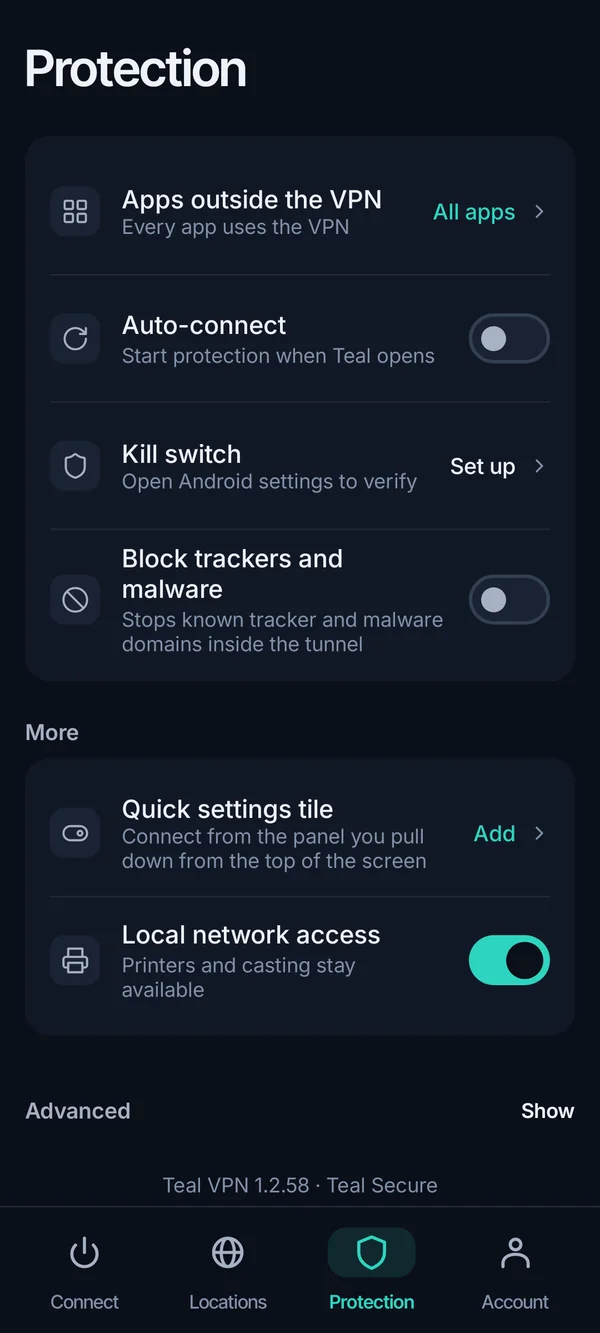
Even a perfect no-logs VPN cannot help if your DNS lookups go to your internet provider instead of through the tunnel, because your provider then has the log the VPN refused to keep.
Teal VPN's leak test at tealvpn.com/ip-leak-test shows your public IP and the DNS servers answering your lookups; it needs no sign-in and works with any VPN. For a second opinion, dnsleaktest.com and browserleaks.com show the same two things from a different vantage point.
With the VPN connected, the public IP should belong to the VPN server's country and the DNS servers should not carry your internet provider's name. If either is wrong, reconnect, switch the DNS setting in the app, and run it again before you blame the policy.
Keep reading
References
- X-VPN Announces Successful Completion of Independent No-Logs Audit
- The best VPNs for protecting your privacy - Techlicious
- Octohide: Privacy, Logs & Security
Need help with Teal? Contact support.
Questions
What does no logs actually mean?
It means the provider does not record the sites you visit, your DNS lookups, your real IP address, the server you used or your connection times. Aggregate server load counts are normal and do not identify you.
Does Proton VPN have an audited no-logs policy?
Yes, Proton VPN publishes independent audit reports of its no-logs policy on its own site. Read the newest report for its date and the exact list of data it covers rather than the summary line.
How do I choose a no-logs VPN provider?
Read the policy for a list of data not kept, find a dated audit report, check the app store data section for advertising identifiers, and run a leak test while connected. A named company behind the service is the fifth check.
Does Teal VPN keep logs?
Teal VPN keeps no browsing logs and shows no ads on any plan, checked 31 October 2026. We have not published a third-party audit yet, and we say that plainly rather than show a badge.
Is there a VPN that costs nothing and keeps no logs?
A few exist, but most apps that charge nothing live on ads or data. Teal Free gives 500 MB a day on 2 devices with no ads and no browsing logs; the daily cap is what pays for that.
Does a no-logs VPN still see my real IP while I am connected?
Yes, the server must see your IP to send traffic back to you. No logs means that IP is not written down or linked to what you did, not that it was never seen.
Is a no-logs VPN the same as being untraceable?
No. Your account email, your payment record and anything you type into a website still exist. A no-logs VPN removes one record, the provider's, and leaves the rest to you.